
Borrelia burgdorferi and Gynepathologies
-
DOI: 10.1101/2025.03.03.25323258
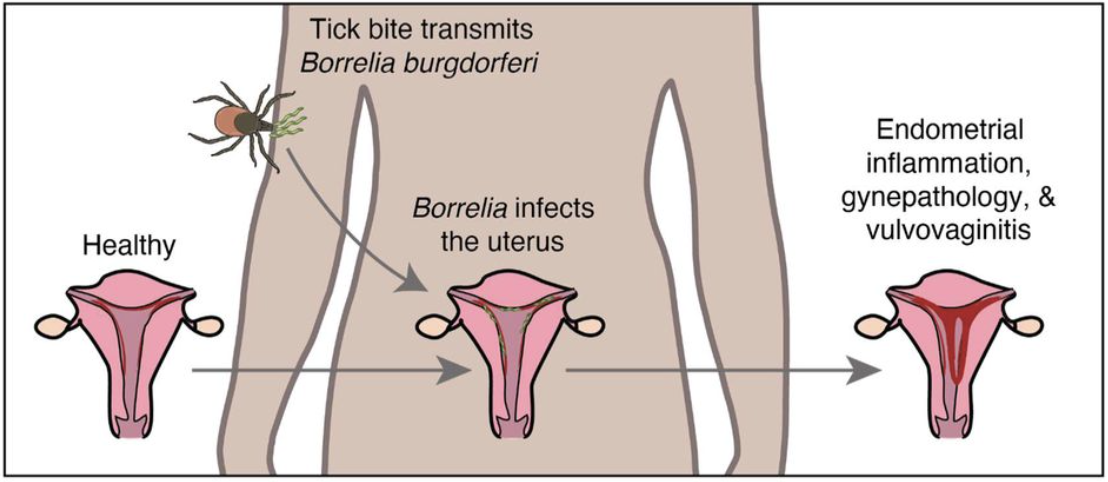
Lyme disease (LD) is an illness caused by the spirochete Borrelia burgdorferi (B. burgdorferi). Borrelia is known to disseminate through organs, including the skin, joints, spinal cord, bladder, and heart, leading to Lyme arthritis, neuroborreliosis, and Lyme carditis. While previous studies have investigated the impact of LD on pregnancy in both mice and humans and have found the presence of B. burgdorferi in the uterus of mice, we studied the impact of LD on the non-pregnant female reproductive tract. We use a mouse model for LD and find an ongoing and severe infection of the reproductive tract of female mice, which persists up to 15-months post-inoculation. This infection results in uterine glandular cysts and endometrial hyperplasia as well as vaginal epithelial thickening, polymorphonuclear and mononuclear cell epithelial infiltration, and epithelial desquamation into the vaginal lumen. Strikingly, we find that age has an impact on the extent of gynecologic pathology such that aged female mice (1-year old) that are reproductively senescent have more gynecologic pathology with infection compared to young mice (15-weeks old) when infected for the same length of time. Using large-scale electronic healthcare record data, we report that LD additionally results in increased infection-associated risk of menorrhagia (1.5-fold), miscarriage (1.62-fold), uterine fibroids (1.42-fold), and endometriosis (1.93-fold). Underreporting of gynecological outcomes is pervasive throughout many different infectious diseases, and LD-associated gynecological pathologies may have been similarly underappreciated in the field. This work suggests that further study of the female reproductive tract and the effects of B. burgdorferi infection therein will help clarify and expand the knowledge of myriad LD outcomes.
-
DOI: 10.3389/fmed.2026.1794120
Perinatal transmission of Borrelia burgdorferi sensu lato (Bb), the spirochetal agent of Lyme disease, is an issue of public health importance and research significance. This alternate mode of transmission and the potential risk of adverse pregnancy outcomes were communicated within public health spheres following the first suspected case in 1985. Subsequent studies in reservoir and non-reservoir animal hosts, in addition to case reports of perinatal morbidity and mortality in humans brought further attention to the field. Decades later, however, the incidence and epidemiologic impact of perinatal transmission of Bb, as well as the clinical spectrum and potential long-term health sequelae of gestationally exposed children, remain understudied and poorly defined. In June 2022, a Banbury Conference on Perinatal Transmission of Lyme disease was convened at Cold Spring Harbor Laboratory in New York. This manuscript conveys conference findings and research recommendations to advance scientific and clinical understanding of this important issue.
-
DOI: 10.1038/s44294-025-00120-9
Myalgic encephalomyelitis/chronic fatigue syndrome (ME/CFS) and long COVID are debilitating multisystem illnesses with overlapping symptoms and poorly understood mechanisms. Female sex is a major risk factor, and preliminary evidence links sex hormones and other fluctuating endocrine hormones, including cortisol, aldosterone, and DHEA, to these conditions. However, existing studies have not comprehensively captured diurnal, infradian, and circadian biorhythms, leaving critical gaps in understanding. The MELLOW study (ME/CFS + Long COVID Longitudinal Omics and Women’s Health) is a prospective, chronobiology-based study of reproductive-aged women with ME/CFS, long COVID, and healthy controls. It integrates menstrual-phase and diurnal sampling with multi-omics profiling (genomics, proteomics, metabolomics, lipidomics, steroidomics), physiological monitoring, and symptom tracking. By accounting for natural and disrupted biorhythms, MELLOW will map temporal links between hormonal, molecular, physiological, and symptom dynamics, improving biomarker reproducibility and clarifying endocrine network disruption underlying ME/CFS, long COVID, and women’s health more broadly.